Your website gets visitors. Some buy, book, or message you. Most leave without doing anything. Conversion rate optimization is the work of changing that ratio — turning more of the traffic you already have into customers, without spending more on advertising.
What is conversion rate optimization?
Conversion rate optimization, often shortened to CRO, is the process of improving your website so that a higher percentage of visitors complete a goal you care about. That goal — a conversion — might be a purchase, a booking request, a quote request, or a WhatsApp message. The conversion rate is conversions divided by visitors, as a percentage. If 1,000 people visit your shop and 20 buy something, your rate is 2%. CRO moves that number up by removing friction and making the next step obvious.
Why does conversion rate matter for your business?
Traffic is expensive. Whether you earn it through search, social media, or paid ads, every visitor has a cost. If your website converts 1% of visitors and you raise that to 2%, you have doubled your sales from the same traffic. You did not need twice the visitors — you needed a better website. SEO brings people to your site; CRO makes sure those visits turn into something useful. A guide to improving your Google rankings can help you attract more visitors, but if your landing pages do not convince them to act, much of that traffic is wasted.
How does conversion rate optimization work?
CRO works in a cycle: measure, understand, change, test, and repeat. First find where visitors drop off, form a theory about why, change one thing, test it, and keep the winner. Testing replaces opinion with evidence.
- Measure: track how many visitors convert, and where they leave.
- Understand: watch how people use your site and what they ask before buying.
- Change: fix the biggest problem first, not the easiest one.
- Test: compare the new version with the old one and keep the winner.
What is a CRO audit?
A CRO audit is a structured review of your website before you change anything, showing where conversions leak and which pages deserve attention first. Start with your homepage, main service or product pages, and checkout or contact pages.
Check your analytics and map your funnel
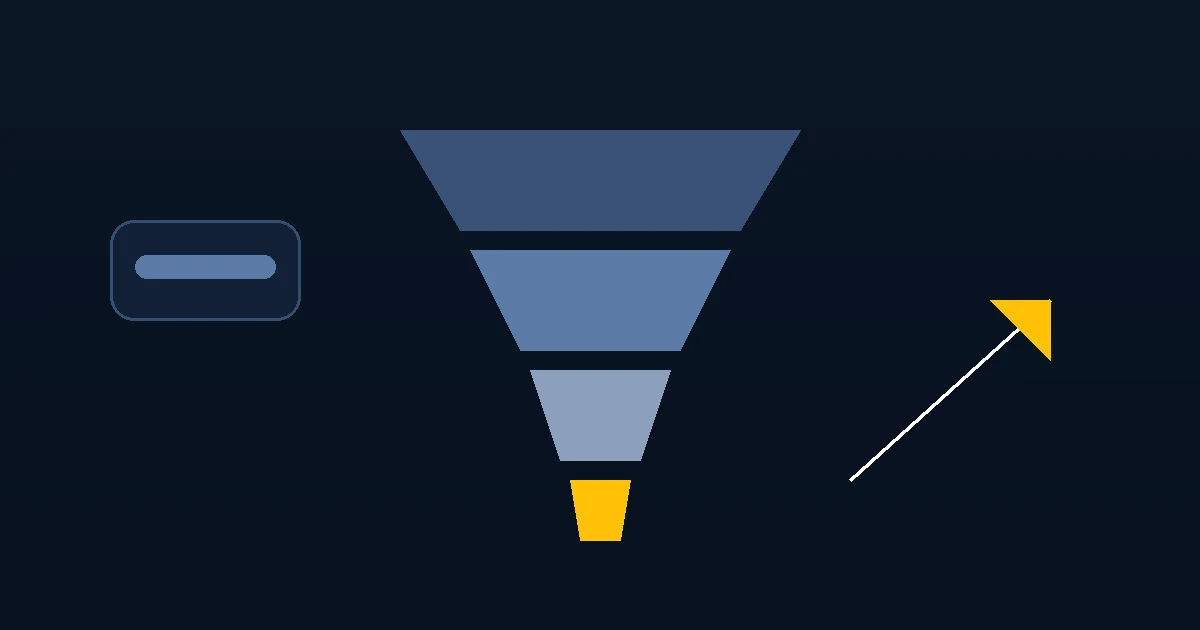
Look at your analytics to find which pages get the most traffic, where people leave, and where the funnel breaks down. If most visitors reach your product page but few reach the checkout, the problem is on the product page. Set up conversion tracking first: in Google Analytics, a conversion is recorded when a visitor completes a defined action, such as submitting a form (see Google Analytics Help). Then map your funnel — for a shop: homepage, product page, basket, checkout, confirmation. The step with the biggest drop is your priority.
Review forms, speed, and trust signals
Forms are where many conversions die. Count the fields on your main form — every field is a reason to abandon it. A quote request usually needs a name, a WhatsApp number, and a short description, not a full postal address. Check the form on a phone: most visitors in Egypt, Saudi Arabia, and the UAE browse on mobile. A slow page also loses visitors, so compress your images. And check trust signals: a real phone number, a WhatsApp button, honest reviews, and a plain-language returns policy. If your site needs a faster, cleaner structure, a professional website design for businesses can address speed, layout, and mobile usability together.
What should you optimise first?
Start with the page that has the most traffic and the lowest conversion rate, or the funnel step with the biggest drop-off.
- Fix anything broken — dead links, forms that do not submit, pages that do not load on mobile.
- Fix your most visited landing page — the page most new visitors see first.
- Fix your main form or checkout — the step closest to the conversion.
- Then smaller improvements — headlines, images, button text.
Avoid a full redesign: small changes on one page at a time are faster and easier to learn from.
How do you improve a landing page?
Landing page optimization means making one page do one job well: convince the visitor to take one specific action. If your ad promises a discount on web design, the landing page should show that offer immediately — not a general homepage with ten services. When the page matches what the visitor expected, they stay. When it does not, they leave within seconds.
Write a clear headline
Your headline should say what you offer and who it is for, in plain words. “Web design for small businesses in Cairo” is clearer than “Digital solutions for the modern enterprise.” Support it with one short sentence about the benefit — a clinic might say: “Book a dental check-up online in under two minutes.”
Use one clear call to action
Every landing page needs one main action, repeated in the same words each time. If the action is “Request a quote on WhatsApp,” do not also push a newsletter signup with equal prominence. Make the button easy to tap, with a label that describes the outcome — “Get my quote” beats “Submit.” Put your strongest trust signal close to the button, such as “Free returns within 14 days” next to the buy button.
How do you improve your forms?
A good form feels short, easy, and safe. Remove every field that is not essential to your first reply — you can collect extra details later. A service business asking for a name, a WhatsApp number, and a one-line description will get more enquiries than one asking for ten fields up front.
Split long forms and confirm what happens next
If a form genuinely needs several steps — a booking form with a service choice, a date, and contact details — split it into steps and show progress: “Step 1 of 3.” After submission, say what happens next — and keep that promise.
Test your form on a phone
Check every form on a real mobile device: fields large enough to tap, the keyboard clear of the submit button, and error messages that say what to fix.
What is A/B testing and how do you run one?
A/B testing is the core method of conversion rate optimization. You create two versions of a page — A, the original, and B, the changed version — and show each to a different group of visitors, then compare which converted more.
Step 1: Choose one thing to test
Pick a single change with a clear theory, such as: “Shortening the checkout form from eight fields to four will increase completed purchases.” Changing several things at once tells you nothing.
Step 2: Decide what success looks like
Write down the metric you will judge the test by — usually the page’s conversion rate: completed purchases, submitted forms, or WhatsApp clicks. Do not judge a test by page views or time on page.
Step 3: Split traffic and let the test run
Show version A to half your visitors and version B to the other half, at random. Do not stop after a few hours — early results are noisy. Let it run for at least a full week, until you have enough conversions to trust the result.
Step 4: Keep the winner and record what you learned
If version B clearly converts better, make it permanent. Either way, write down what you tested and what happened, so you do not repeat failed ideas.
What should you test first?
Start with the tests closest to the conversion.
Test your headline and call to action
Test a headline that states a clear benefit against one that states a feature: “A website that brings you more customers” versus “Responsive web design services.” Test button wording too: “Book my appointment” often beats “Submit.”
Test your form length, images, and offer
Test a short form against your current form, a real photo of your product, clinic, or team against a generic stock image, and different offers — a shop might test free delivery against a percentage discount.
How do you measure conversion rate optimization?
Track three things: each key page’s conversion rate before and after each change; funnel drop-off at each step; and traffic source, since a page may convert well for search visitors and poorly for social visitors. Review your numbers weekly and look for trends over several weeks, rather than reacting to one day’s results. Be careful with small numbers: a change from one conversion to two proves nothing.
What are the most common conversion rate optimization mistakes?
Changing everything at once
Redesigning a whole page in one go teaches you nothing. If conversions rise, you do not know why. If they fall, you do not know what to undo. Change one thing, test it, then move on.
Testing without enough traffic
A test on a page with very few visitors gives a random result. Check first that the page gets enough traffic and conversions for the result to mean something; if not, test a busier page.
Optimising for clicks instead of customers
A sensational headline might get more clicks, but if those clicks do not convert, you have made things worse. Judge every change by conversions and by the quality of the enquiries, not by clicks alone.
How is CRO different from SEO?
SEO and CRO answer different questions. SEO asks: how do we get more people to visit our website? CRO asks: how do we get more of those visitors to become customers? SEO brings traffic through rankings, content, and technical health; CRO turns it into enquiries and sales through better pages, clearer offers, and easier forms. A site with strong SEO and weak CRO gets many visitors and few customers; a site with strong CRO and weak SEO converts well but has too few visitors to grow. If you are building or rebuilding your site, plan both together — a web design and development service that considers search visibility, page speed, and conversion from the start.
Frequently asked questions
What is a good conversion rate?
There is no single number that counts as good for every business. Judge progress against your own baseline, not another business.
How long does conversion rate optimization take?
You can complete a first audit and fix the most obvious problems within a few weeks. Meaningful, tested improvements take longer, because each A/B test needs enough traffic and time to produce a reliable result.
Do I need special software for A/B testing?
Not to start. Your analytics tool can show conversion rates before and after a change, which is enough for simple comparisons on a small site.
Can CRO help a small business with little traffic?
Yes, but differently. With low traffic, formal A/B tests take too long to give reliable results, so focus on the audit: fix broken forms, shorten long forms, clarify your headline, add trust signals, and improve page speed. Those fixes help every visitor.
How do you keep improving after your first wins?
Each month, pick one page or funnel step, audit it, form one theory, and run one test. Write down the result. Over a year, twelve small tested improvements will change your website far more than one large redesign.
Start improving your conversion rate with Focus Marketing
Audit your funnel, fix the biggest leaks, test one change at a time, and measure the result — starting with your busiest page and main form. Focus Marketing can review your site and work through the audit, testing, and improvements with you. Message us on WhatsApp at 01099038936 or follow us on Instagram at @focus.pr0o. You can also explore our work and services on the Focus Marketing homepage.